Collaborative Navigation Improves Spatial Learning Across Symmetric and Asymmetric Locomotion in Virtual Reality
Soumyajit Chakraborty 1, Holly Gagnon 1, Timothy McNamara 1, and Bobby Bodenheimer 1
1 Vanderbilt University
Multi-user virtual reality (VR) systems support multiple locomotion methods, but coordination may be challenging when partners use different methods. We studied dyads navigating a shared virtual maze using symmetric (same) or asymmetric (different) locomotion methods—specifically, steering (continuous movement with physical turning) and teleportation (point-and-teleport within 30 meters with physical turning)—and assessed survey knowledge using direction and straight-line distance estimates between objects. We found that (1) dyads acquired better survey knowledge than individuals across locomotion conditions; (2) teleportation showed no significant difference from steering in distance error and yielded significantly lower angular error; (3) asymmetric locomotion methods did not significantly increase cybersickness compared to symmetric locomotion methods; and (4) symmetric and asymmetric dyads showed no significant differences in distance or angular errors. Overall, these results suggest that collaborative navigation improves spatial learning and that asymmetric locomotion can improve accessibility without significantly increasing cybersickness in multi-user VR applications.
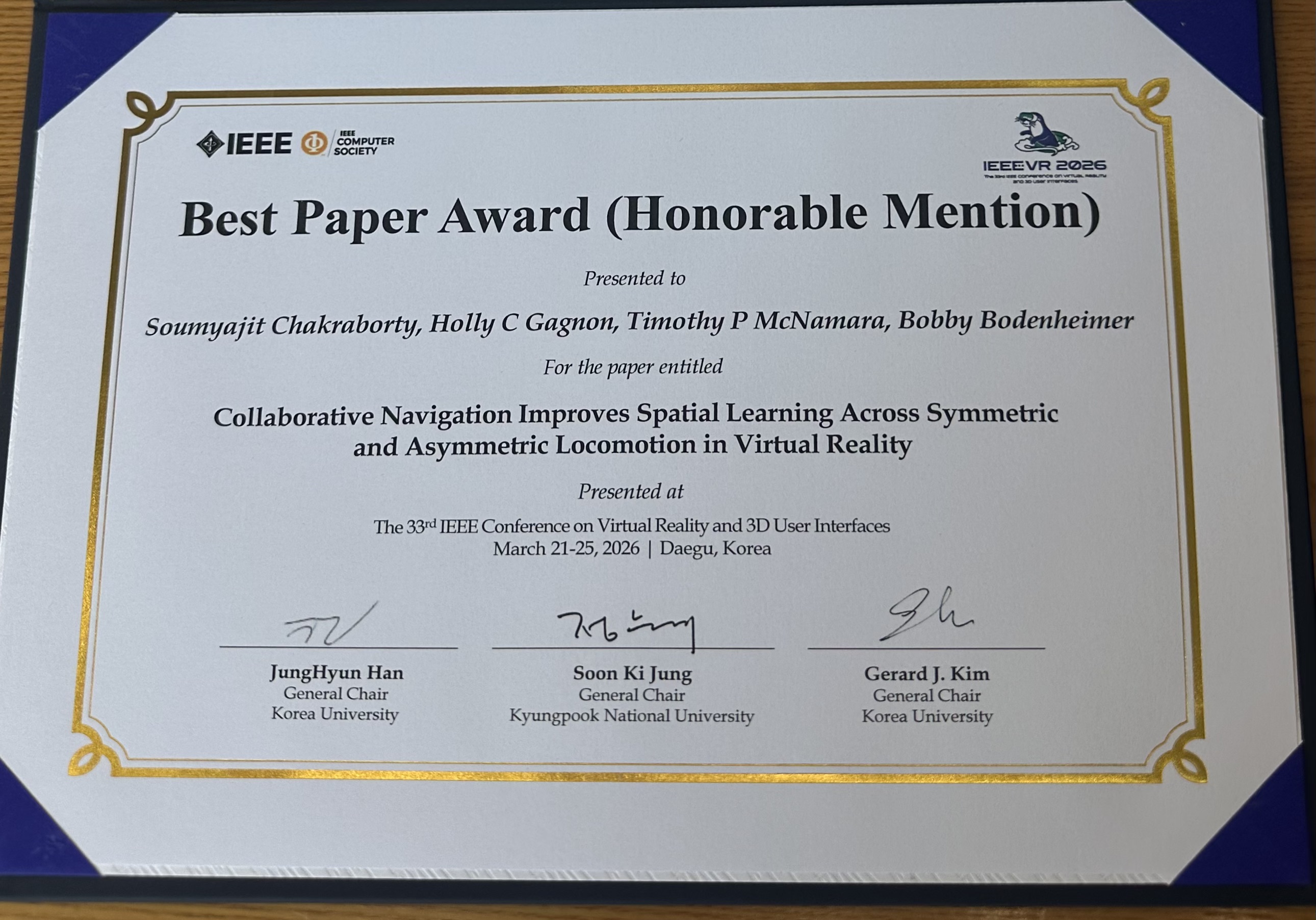
Bobby presented our paper at the IEEE VR 2026 conference in Daegu, South Korea. Here is the link of the paper. The presentation video of the paper at IEEE VR 2026 and a short overview of the paper can be found in the videos below. We also got "Best Paper Honorable Mention Award" for the paper. An image of the award is shown below.